


 By
By In this guide, we break down Coast FIRE and Lean FIRE in complete detail. When comparing Coast FIRE and Lean FIRE, most people don’t realize how different these two paths truly are.
Tools & Resources Referenced in This Article
| Tool | What it does |
| FIRE Number Finder | 25x your annual expenses – instantly calculate your finish line (see calculator box below) |
| Coast FIRE Calculator | Find your exact Coast number by age, target retirement date & expected return |
| Lean FIRE Planner | Map a lean budget and see your FIRE date in real time based on savings rate |
| 4% Rule Simulator | Test how long your portfolio lasts under different spending scenarios |
| Personal Capital (Empower) | Free net-worth tracker with retirement planning dashboard |
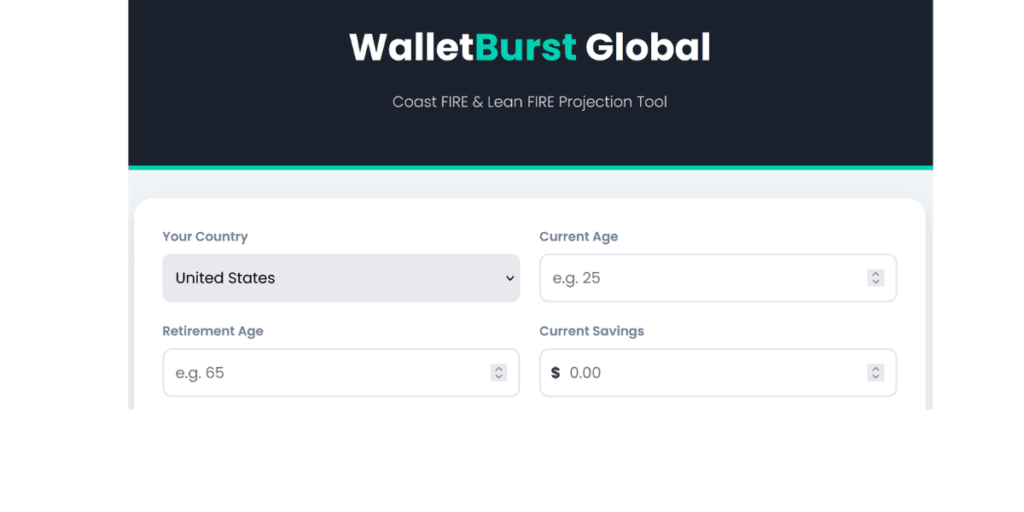
�� FIRE Number Finder Tool
Use this simple formula to instantly find your FIRE number:
Your FIRE Number = Annual Expenses x 25
Coast FIRE Number = Full FIRE Target ÷ (1.07)^Years to Retire
Example: Spend $40,000/year → FIRE Number = $1,000,000 | Coast Number at age 35 = ~$131,000
Lean FIRE: Spend $30,000/year → FIRE Number = $750,000 (25x rule)
Coast FIRE: Hit ~$131K–$350K early → let compounding do the rest by age 65
What is Lean FIRE?
Lean FIRE is financial independence achieved on a tight, minimalist budget – typically below $40,000 per year for a single person, or roughly $25,000-$35,000 depending on where you live. The word ‘lean’ does all the heavy lifting: you are retiring early, but you are doing it on lean spending, not luxury.
The goal is to reach your FIRE number (25x your annual expenses, per the 4% rule) as fast as possible – even if that means a stripped-down lifestyle now and forever. Think: renting in a low-cost city, no car payments, minimal dining out, and very little discretionary spending. It’s extreme by mainstream standards, but liberating by FIRE community standards.
What is Coast FIRE?
Coast FIRE is a fundamentally different idea. Instead of retiring immediately after reaching your number, you reach a ‘coast number‘ – an invested amount large enough that, if you leave it alone, it will grow to your full FIRE number by traditional retirement age (around 65) without you adding another dollar.
Once you hit your Coast number, you stop aggressively saving and switch to ‘coasting‘ – covering your living expenses with part-time, low-stress, or flexible work, without needing to save anything extra. The compound growth engine does the rest.
Deep Run: The Numbers
Let’s say your target FIRE number is $1,000,000 (spending $40K/year at 4% withdrawal). Here’s how the math plays out for each strategy:
| Lean FIRE Path: Aggressive saving, early exit | Coast FIRE Path: Save hard early, coast later |
| Save 50-70% of income aggressively | Invest aggressively in your 20s or 30s |
| Reach $625K-$1M total portfolio | Hit Coast number (~$350K at age 35) |
| Fully stop working – forever | Only earn enough to cover living costs |
| Timeline: 7-15 years from high income | Portfolio grows on autopilot until 65 |
| Requires deep, permanent spending cuts | Work continues but without pressure |
Example: If you invest $350,000 at age 35 at a 7% average annual return, it grows to approximately $2.66 million by age 65 – without a single additional contribution. That’s the compounding miracle that makes Coast FIRE work.
For Lean FIRE, the math is simpler but harsher: live on $30K/year, and you only need $750,000 to retire. That’s achievable faster, but requires accepting $30K/year as your permanent ceiling for life.
What is the Main Difference Between Coast FIRE and Lean FIRE?
| Lean FIRE: Stop working. Live small. | Coast FIRE: Stop saving. Work lighter. |
| Goal: fully retire early – no income needed | Goal: stop needing to save, not stop working |
| Trade-off: permanently frugal lifestyle | Still earn money – just without pressure |
| Freedom is total. Budget is tight. | Freedom is partial but lifestyle is relaxed |
| Perfect for minimalists who hate work | Perfect for those who enjoy flexible work |
In plain language: Lean FIRE trades lifestyle for time. Coast FIRE trades timeline for lifestyle quality. Neither is wrong – they’re just different bets on what ‘freedom’ means to you personally.
Pros & Cons of Lean FIRE
| ✅ Pros | ⚠️ Cons |
| Fully retire early (30s or 40s) | Tight budget leaves almost no buffer |
| Zero dependence on a job | Healthcare costs can derail plans |
| Simpler, lower-stress lifestyle | Sequence-of-returns risk is dangerous |
| Faster to achieve than Fat FIRE | Lifestyle inflation is not possible |
| Forces intentional spending habits | Can be socially isolating long-term |
Pros & Cons of Coast FIRE
| ✅ Pros | ⚠️ Cons |
| Reduced financial stress immediately | Still need income for decades |
| Work becomes a choice, not a must | Market downturns can push back timeline |
| Maintain normal lifestyle spending | Discipline needed not to dip into savings |
| Easier to reverse or adjust course | Full retirement still far away |
| Lower Coast number = reachable faster | Less dramatic lifestyle change upfront |
Which Should You Choose?
Who Should Choose Lean FIRE?
- You hate your job and want out as fast as possible
- You already live minimally and genuinely love it
- You have low fixed expenses (own home, no dependents)
- You value time over comfort and luxury
- You are single or have a like-minded partner
- You live in a low cost-of-living area or plan to relocate
Who Should Choose Coast FIRE?
- You like your work but want far less financial pressure
- You have a family or lifestyle you are not willing to compromise
- You started investing young – compound math is on your side
- You want a safety net before fully quitting the workforce
- You are in your 20s with high earning potential ahead
- You value flexibility over speed in reaching full retirement
FAQs
What is the difference between Lean FIRE and Coast FIRE?
- Lean FIRE = fully retire early on a tight budget.
- Coast FIRE = stop saving aggressively but keep working lightly until traditional retirement.
What are the downsides of coast FIRE?
You still need income for decades and a market crash can push your retirement timeline back significantly.
What is the difference between Coast FIRE and regular FIRE?
- Regular FIRE means fully retiring immediately.
- Coast FIRE means your investments grow on autopilot while you still work just enough to cover living expenses.
What is considered Lean FIRE?
Retiring early on $25,000-$40,000 per year – a minimalist lifestyle with a portfolio of roughly $625K–$1M.
What’s the worst firewood to burn?
Pine and other softwoods – they burn fast, produce excess smoke, and leave heavy creosote buildup in chimneys.
What is Dave Ramsey’s 8% rule?
Dave Ramsey suggests you can safely withdraw 8% of your portfolio annually in retirement – though most financial experts recommend the more conservative 4% rule instead.
Coast FIRE and Lean FIRE: Which Is Right for You?
The biggest question people ask is - Coast FIRE and Lean FIRE, which one actually works? Both Coast FIRE and Lean FIRE are proven paths to financial independence. Choosing between Coast FIRE and Lean FIRE depends entirely on your lifestyle goals.
Conclusion:
Whether you choose Coast FIRE and Lean FIRE strategies together or separately – start today.
3 Comments